
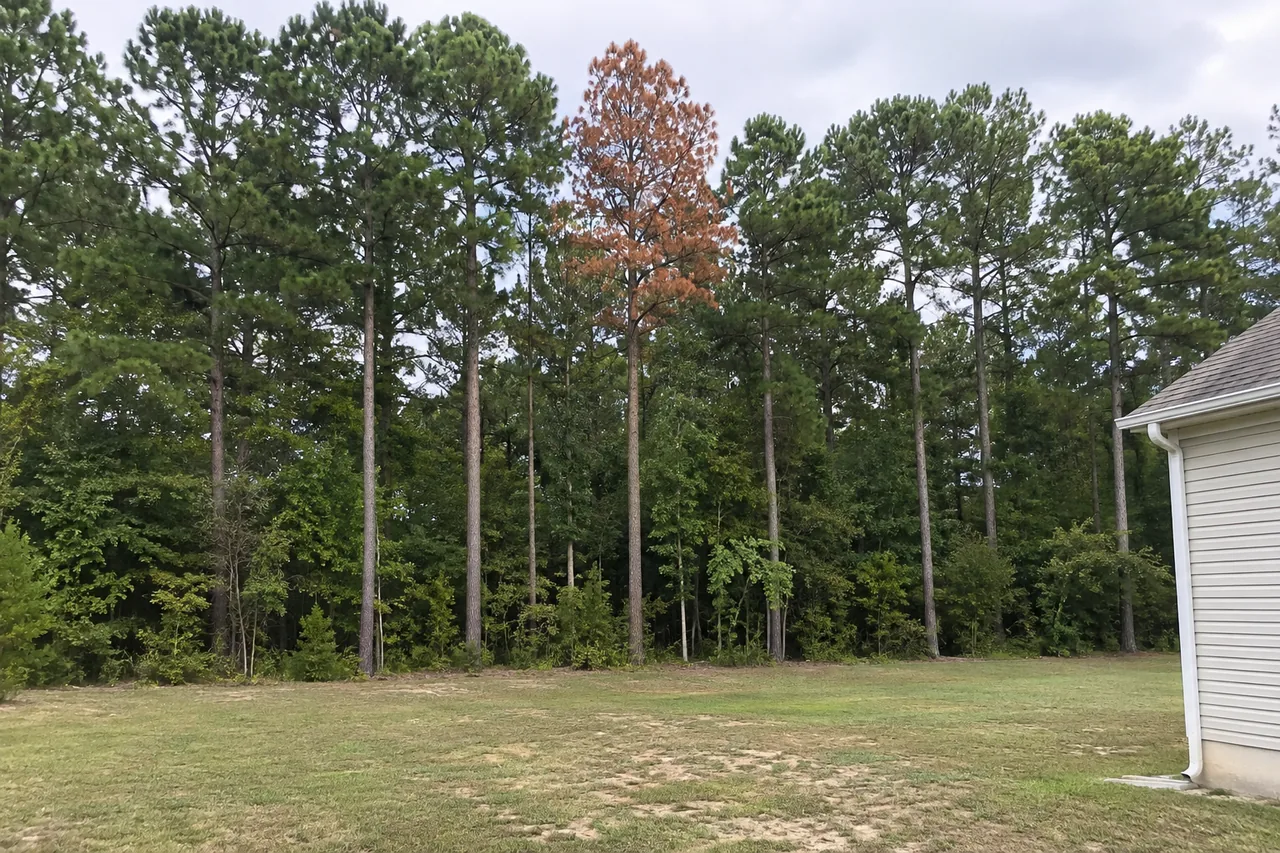
A pine turning rust-red: beetle, salt or drought?
A loblolly that fades from green to yellow to rust is the call that comes up most in pine country. In Sussex County there's more than one possible cause.
- Southern pine beetle. In its 2016 forest health report, the Delaware Forest Service described 25 acres of southern pine beetle kill in overmature loblolly pine bordering a salt marsh in Sussex County, an attack that had moved through the stand the year before. The Forest Service's species profile notes that beetle outbreaks often begin in trees already stressed by drought, fire or logging.
- Salt spray and brackish water. The same 2016 survey checked discolored pines along salt marshes and tidal rivers on the ground and found that most of the red needles came from salt spray or brackish flooding, not beetles.
- Low beetle numbers lately. By 2022 the state's beetle traps in Sussex County caught very few: 13 at Redden State Forest over the spring and none in the other traps, which the report read as another year of low or declining populations.
For a homeowner, the cause matters less than the result. A pine that has gone fully brown is dead or dying. If it is tall enough to reach the house, the deck, the driveway or a neighbor's roof, have it looked at before the next storm rather than after. If the color is only on the side facing the water, mention that too.
When a lean is new
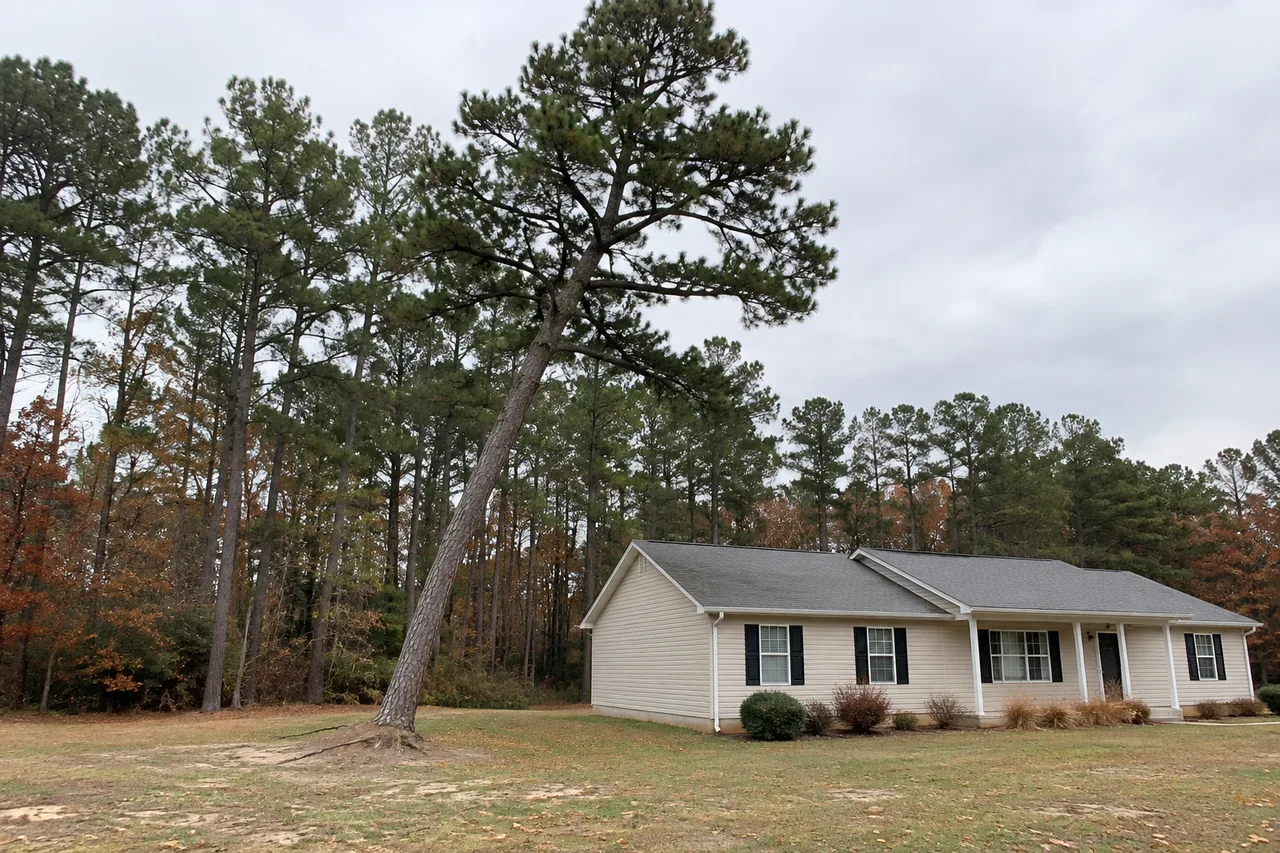
Plenty of trees grow with a lean toward the light and stand that way for decades. A lean that wasn't there last month is different, and Sussex County's ground explains why it happens.
The Forest Service's loblolly profile says the species is fairly windfirm on deep soils, but that windthrow is common on shallow ones. USDA's description of the Fallsington soil series, which occurs in Delaware, gives it a seasonal high water table within a foot of the surface from December through May. That is the same stretch of the year when nor'easters and winter storms come through. Put the two together, and a tall pine on a low, wet lot is the tree to keep an eye on between December and May.
Things worth putting in your request:
- soil cracked or mounded up on the side away from the lean;
- roots lifting out of the ground on that side;
- a lean you notice after a storm that you never saw before;
- a fence, shed or the house now closer to the trunk than it was.
A new lean toward a building is one of the situations where a call shouldn't wait.
What else to look for and report
Nobody can judge a tree's risk from a website. What you can do is notice and describe, so the contractor knows what to look at closely:
- dead branches in the crown, especially over the roof, the drive or a play area;
- cracks or splits in the trunk, or a fork that has started to separate;
- mushrooms, soft wood or hollows at the base;
- bark falling away in sheets;
- a crown that leafed out thin or not at all this spring;
- on Leyland cypress, scattered branches yellowing and then turning reddish brown, and dark, cracked patches on the bark, which University of Maryland Extension describes as canker symptoms.
Photos help. A picture of the whole tree and one of the base usually tell the contractor more than a description.
Trees that rank lowest for wind
A University of Florida Extension publication on wind resistance sorts Coastal Plain trees into four groups based on how they held up in hurricanes. Among trees common in Sussex County yards, Bradford pear and Leyland cypress fall in the lowest group, along with water oak and laurel oak. Loblolly pine, red maple, willow oak and black cherry sit in the medium-low group. Sweetgum ranks medium-high, and American holly and southern magnolia rank highest. A companion UF publication on lessons from hurricanes suggests considering removal of lowest-group trees, especially over-mature ones that endanger life or property.
NC State Extension's plant notes add detail: Bradford pear forms weak crotches that break with age, wind and ice; willow oak is susceptible to wind damage; and red maple's branches can break in wind and ice. The Sussex County trees page goes species by species.
After snow and ice
Winter loads break trees too. The Delaware Forest Service's 2022 report noted that a January 29 snowfall that year caused further branch and trunk damage to conifers and American holly. The February 2026 blizzard brought up to 21 inches of snow near Long Neck, by National Weather Service count, along with high winds. A tree that came through a storm like that with a split top, a hanging limb or a new lean is weaker than it looks from the ground.
Hanging limbs, sometimes caught in the crown above a path or driveway, are easy to miss once the snow melts. Look up before you walk under a tree that took a hit.
Rules for removing a hazard tree
- Rehoboth Beach. The city code allows a removal permit for a tree the city finds to be dead, significantly diseased, severely injured or in danger of falling, or one that creates a material hazard. Its permit fee is waived for a tree the city determines is dead, and trees damaged beyond saving by storms, insects, disease or fire, or that are an immediate peril as the city decides, are exempt. City arborist: 302-227-6181, ext. 207 (checked Nov 9, 2026).
- Dewey Beach. A permit is needed for trees 20 inches or more around. Removing one to protect people or property, or because it's unlikely to survive, calls for a signed statement from an arborist. When a tree threatens imminent harm in a storm or emergency, the owner notifies the building official and may remove it (checked Nov 9, 2026).
- Elsewhere. In unincorporated Sussex County, Lewes, Milton, Georgetown and Millsboro, the pages read for this site showed no permit for removing a tree from an existing home lot (checked Nov 9, 2026). See the rules guide.
When the dead tree is next door
Start with a conversation, and photos of the tree from your side. Rehoboth's own trees page suggests the same first step: the owner may not realize the tree is affecting your property. If it falls, call your insurer about any damage to your property. For a dispute over who must remove a tree, talk with a lawyer; this site doesn't give legal advice.
Mistakes with dead and leaning trees
- Waiting to see if it greens up. A pine that is brown from top to bottom won't.
- Climbing a dead tree yourself. Leave the climbing and the cutting to the crew.
- Ignoring a new lean in winter. Winter is when low Sussex lots are wettest and when the big storms arrive.
- Cutting first in Rehoboth or Dewey. Check whether the town treats it as an emergency exemption before the saw starts.
- Not mentioning what's underneath. A dead tree over a garage is a different job from one in the woods.
Questions about failing trees
My pine went from green to rust in a few weeks. Is it gone?
If the whole crown has turned, almost certainly. Whether the cause was beetles, salt or drought, a fully brown pine near a building should be looked at soon.
Is every leaning tree dangerous?
No. A tree that has grown with a steady lean for years is different from one that has just started to tilt, especially with soil cracking or lifting on the far side. Describe which you have.
Only half my Leyland cypress is brown. Will the rest die?
Canker fungi spread from branch to branch in rainwater, according to University of Maryland Extension, and fungicides don't control them. The Leyland guide covers pruning out infected branches versus removing the tree.
Who decides whether a tree is a hazard?
The contractor who comes out will give you an opinion and a price. In Rehoboth Beach and Dewey Beach, the town also has a say before it comes down.
A request from this site goes to one independent contractor who works in Sussex County. The site doesn't assess or cut trees.
- Delaware Forest Service, Forest Health Highlights 2016 and 2022.
- USDA Forest Service Fire Effects Information System, Pinus taeda (Carey, 1992). USDA soil series description, Fallsington.
- Duryea and others, Selecting Coastal Plain Species for Wind Resistance, UF/IFAS Extension FR174; Duryea and Kampf, Wind and Trees: Lessons Learned from Hurricanes, UF/IFAS Extension FR173. NC State Extension Plant Toolbox: Pyrus calleryana, Quercus phellos, Acer rubrum.
- University of Maryland Extension, Seiridium and Botryosphaeria canker of Leyland cypress.
- NWS Mount Holly, February 22–23, 2026 storm summary.
- City of Rehoboth Beach Code Chapter 253 and Trees page; Town of Dewey Beach Code Chapter 173. Checked Nov 9, 2026.