
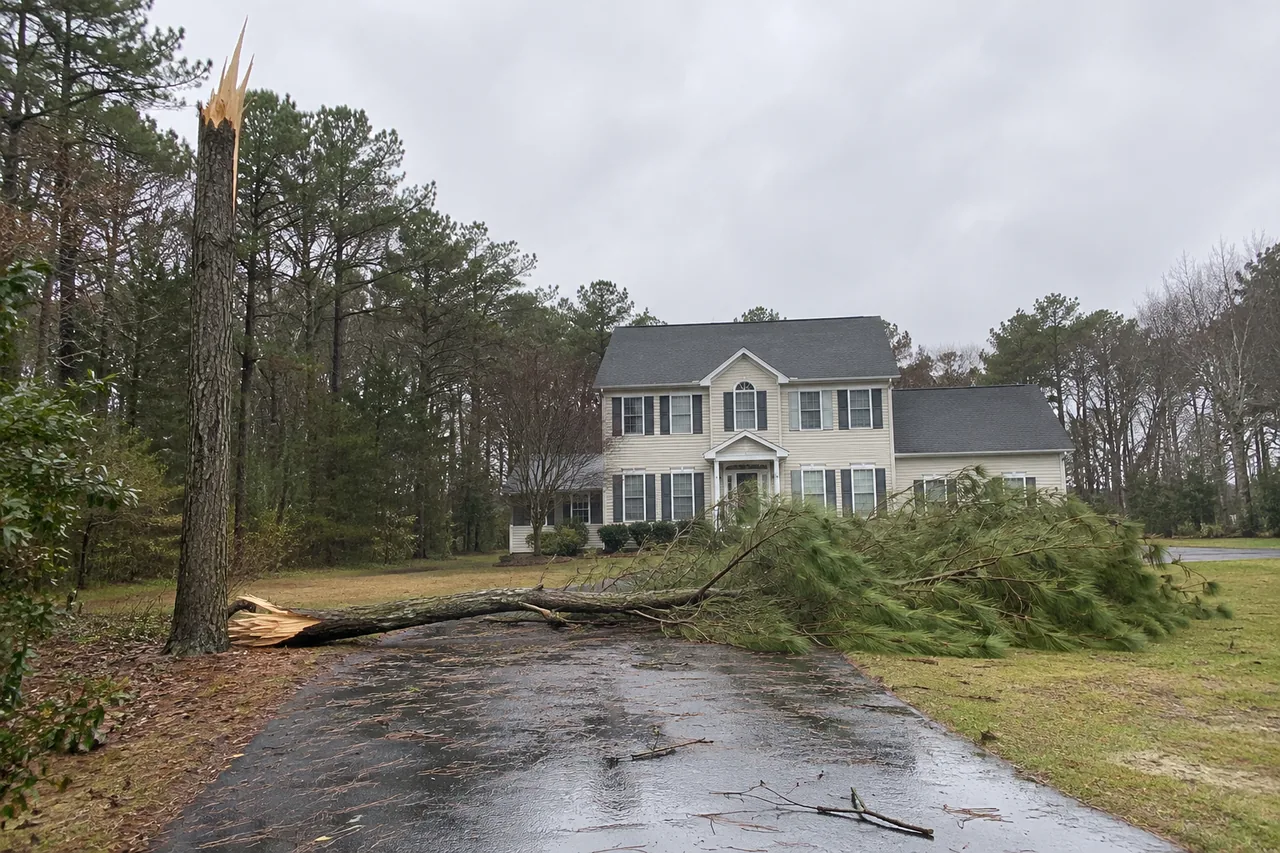
Why a fallen tree is an emergency
Trees and limbs do real harm in Delaware storms, and the official record is plain about it:
- During Tropical Storm Isaias on August 4, 2020, a family member reported a 73-year-old Milford woman missing. Delaware State Police searched the area along her street and found her beneath a large branch that had broken off a tree and come down on her.
- Elsewhere in Delaware, outside Sussex County: on June 30, 2025, during a severe thunderstorm in Wilmington, up in New Castle County, a tree fell into the road directly in an SUV's path. State Police reported that a 79-year-old passenger died at the scene and the driver was seriously hurt.
- In the February 22–23, 2026 blizzard, Sussex County reported wind and heavy snow bringing down trees, poles and power lines, with as many as 23,000 Delmarva Power and Delaware Electric Cooperative customers in the county without power.
- Delmarva Power said in January 2026 that downed trees, limbs and other debris cause about half of all power outages during storms (checked Nov 9, 2026).
A tree resting on a roof can shift as the wind changes or as rain soaks into the branches. A tree falling into a road at night is what killed the Wilmington passenger. Treat both as dangerous until someone with the right equipment has dealt with them.
First steps, in order
- Get people out of the rooms under it. If the roof is pierced or a wall is cracked, stay out of that part of the house.
- Stay away from wires. Delmarva Power's guidance is to assume every downed line is energized and never approach or touch one, even if it doesn't spark. If anyone is hurt, there's a fire or someone could be shocked, call 911.
- Call the utility on your bill. Delmarva Power: 1-800-898-8042. Delaware Electric Cooperative: 855-332-9090. Inside Lewes, the Board of Public Works: (302) 645-6228, which rolls to an on-call service after hours (checked Nov 9, 2026).
- Take photos. The Delaware Department of Insurance's 2013 storm tips tell homeowners to photograph damage before making any repairs.
- Stop further damage once it's safe. The same guidance says it's on the homeowner to prevent more damage, such as covering a hole in the roof, and that insurers typically reimburse those temporary repairs. Keep every receipt.
- Call your insurer, then a contractor. Say whether the tree is on the house, on wires, or blocking the only way in or out.
Who handles which tree
| Where the tree is | Who to call |
|---|---|
| On your house, car or yard | Your insurer and a tree contractor. If the tree came from a neighbor's yard, tell your insurer that as well. |
| Tangled in power lines | The utility on your bill. Nobody should cut it until the line is dead. |
| Across a state road | DelDOT's Transportation Management Center: 302-659-4600, or #77 from a cell phone (checked Nov 9, 2026) |
| Across a town street | That town's public works or town hall |
| Across a private development road | The homeowners' association or community manager |
Delaware law (17 Del. C. §525) lets DelDOT remove or trim trees in its own rights-of-way. DelDOT's own count, published in 2014, put about 89 percent of Delaware's roads in its care, but not private subdivision streets or roads a town maintains (checked Nov 9, 2026).
How homeowner insurance tends to treat trees
Policies differ, so your own declarations page and your adjuster have the final word. The Delaware Department of Insurance's June 2013 storm guidance gives the general picture: most policies do not cover damage to trees or landscaping, but many policies include an allowance for debris cleanup, and when a fallen tree is what caused a power outage, the cost of cleaning up that tree may be covered by homeowners insurance (checked Nov 9, 2026). Ask your agent which applies to you.
What usually matters to the claim is what the tree hit. A trunk on the roof is a different claim from a trunk lying in the lawn. Photos of the tree in place, before anything is cut, help either way. Have the contractor's written price spell out what's on the house, what's on the ground, and what each part costs, so your insurer can see the split.
The brush after a storm
A storm cleanup leaves far more brush than a planned removal, and Delaware's rules narrow the options:
- Burning. Only cut or fallen branches from your own property, only October 1 through April 30, 8 a.m. to 4 p.m., 27 cubic feet at a time, and only after notifying the Sussex County fire board at 302-856-6306. The State Fire Marshal can ban burning by county, and the National Weather Service can issue red flag warnings against it (DNREC, checked Nov 9, 2026).
- Town pickup. Some towns run extra pickups after big storms. Georgetown's Public Works ran a special storm-limb pickup on March 5, 2026, under the town's usual limits: bundles no longer than 4 feet, no more than 36 inches across, no heavier than 50 pounds (checked Nov 9, 2026).
- Drop-off. Delaware Solid Waste Authority yard waste areas around the county take loose brush and limbs up to 4 inches thick for a fee; a few sites take stumps and logs (checked Nov 9, 2026). See the rules guide for the list.
- Chipping. Most storm jobs end with the contractor chipping on site or hauling the debris. Get it in the price.
Door-to-door crews and storm prices
After Sandy in 2012, the Delaware Department of Justice warned homeowners to be wary of door-to-door solicitations, never to pay for work up front, to make full payment only once the job was finished to their satisfaction, to get a written proposal with the cost spelled out, and to check references. That advice fits every storm since.
State law adds a protection worth knowing. Under Delaware's door-to-door sales chapter, Title 6, Chapter 44, a buyer who agrees to a service of $25 or more somewhere other than the seller's place of business, such as at home, may cancel before midnight of the third business day, and the seller must hand over a written notice of that right (checked Nov 9, 2026). There are exceptions, including a true emergency where the buyer called the seller and signs a handwritten waiver, and repairs the buyer asked the seller to come out for.
On storm pricing, the Delaware pages read for this site show limits on price increases coming through specific emergency declarations rather than a standing statute. The March 2020 declaration, for example, made raising prices more than 10 percent an unlawful practice under the state's consumer fraud law; the February 22, 2026 winter storm declaration contained no price clause (checked Nov 9, 2026). To report suspected fraud or unfair pricing, contact the DOJ Consumer Protection Unit at (800) 220-5424 or consumer.protection@delaware.gov.
What goes wrong after storms
- Cutting before the wires are dead. Delmarva Power says to treat every downed line as energized. A tree touching one is no place to start a saw.
- Climbing onto the problem. Leave trees resting on roofs or hung up in other trees to a crew with ropes and rigging.
- No photos. Once the tree is gone, so is the clearest record of what it hit.
- Paying everything up front. The state's own advice is to pay in full only when the job is done.
- Brush burned at the wrong time. May through September is closed to homeowner brush burning statewide (DNREC, checked Nov 9, 2026).
When this isn't the guide you need
If the storm left a tree standing but cracked, leaning or partly uprooted, start with dead or leaning trees. If the trunk is down and you only want it cut up and hauled, that's ordinary tree removal. If wind knocked over part of a Leyland cypress screen, see Leyland cypress removal.
Storm questions
Can I cut the trunk off the roof myself?
A trunk on a roof is under load in ways that are hard to read from the ground, and the roof itself may not hold a person. That's a job for a crew with rigging, after the utility has cleared any wires.
Will my insurance pay to remove a fallen tree?
The Delaware Department of Insurance said in its 2013 storm tips that most policies don't cover trees and landscaping themselves but many include a debris cleanup allowance (checked Nov 9, 2026). Ask your agent, and photograph everything first.
The power company cut the tree off the line. Will they haul it?
Don't count on it. DelDOT's spokesman said after the 2026 blizzard that the department doesn't handle trees on private property. Ask your utility what it will leave behind, and plan for a contractor.
Do I need a permit to remove a storm-damaged tree?
In most of the county, no. Rehoboth Beach exempts trees damaged beyond saving by weather or that are an immediate peril, as the city decides, and Dewey Beach lets owners remove a threatening tree after notifying its building official (checked Nov 9, 2026).
This site sends storm requests to one independent contractor who works in Sussex County. It runs no crews and makes no promise about when anyone can arrive.
- Delaware State Police releases, August 5, 2020 (Milford) and July 1, 2025 (Wilmington).
- Sussex County, "Sussex County weathering major coastal storm," February 22, 2026. Delmarva Power storm readiness release, January 22, 2026, and customer handbook. Delaware Electric Cooperative and Lewes Board of Public Works outage pages. Checked Nov 9, 2026.
- DelDOT, Report Road Condition page; DelDOT blog, January 21, 2014; 17 Del. C. §525 (Justia). Checked Nov 9, 2026.
- Delaware Department of Insurance, storm tips, June 18, 2013. Checked Nov 9, 2026.
- DNREC open burning pages; Town of Georgetown storm debris notice; DNREC yard waste drop-off list. Checked Nov 9, 2026.
- Delaware Department of Justice, home improvement scam warning, October 31, 2012; Delaware Code Title 6, Chapter 44; Governor's declaration of a state of emergency, February 22, 2026; WGMD on the March 2020 price-gouging order. Checked Nov 9, 2026.
- City of Rehoboth Beach Code Chapter 253; Town of Dewey Beach Code Chapter 173. Checked Nov 9, 2026.