
Which rules apply to your lot
Where the tree stands decides who has a say. Sussex County government covers everything outside town limits, including Harbeson, Long Neck and most of the land around Millsboro and Georgetown. The towns each keep their own code. Here is what the code pages and town pages read for this site showed (checked Nov 9, 2026):
- Unincorporated Sussex County. No permit turned up for taking down a tree on an existing home lot. The forest preservation ordinance County Council adopted in September 2026 applies to new subdivision applications, according to WHYY's report on the vote (checked Nov 9, 2026). Planning and Zoning answers questions at (302) 855-7878.
- Rehoboth Beach. The city's trees page says a permit is generally needed to remove trees on private or public property. Chapter 253 of the city code protects trees 8 inches or more in diameter that are on the city's approved list, among others, and allows removal for reasons that include a dead or badly injured tree, a real hazard, or a listed problem species such as Leyland cypress or Bradford pear. Fees are $25 per tree plus $100 for a 16- to 24-inch trunk or $300 above 24 inches, waived when the city agrees a tree is dead (checked Nov 9, 2026).
- Dewey Beach. Town code requires a permit to remove any tree measuring 20 inches or more around, one foot above the ground. Some removals call for a native replacement tree within 90 days, and improper removal carries a $3,000 penalty (checked Nov 9, 2026).
- Lewes. The city's tree sections deal with new construction: one tree per 2,500 square feet of lot on new homes and subdivisions, and fencing around kept trees during building. Neither one sets up a permit for taking a tree off an existing home lot (checked Nov 9, 2026). Ask City Hall before removing a big tree near the street.
- Milton, Georgetown and Millsboro. The code pages read for this site showed no home-lot removal permit in any of the three (checked Nov 9, 2026). Millsboro's code does forbid damaging trees planted along town streets.
One more case applies everywhere: the road edge. State law gives DelDOT authority to trim or remove vegetation in its rights-of-way, and its permit system lists tree trimming under its "Safety" permit type. If the trunk sits near the pavement, call DelDOT's South District office in Georgetown at (302) 853-1340 before anyone cuts (checked Nov 9, 2026). The rules guide has every town in detail.
Sand, wet ground and small lots
Sussex County soil changes a removal plan more than people expect. USDA soil descriptions show both extremes in the county's part of the Coastal Plain. Evesboro sand is excessively drained, with no water table within six feet. Fallsington soils are poorly drained, with a seasonal high water table within a foot of the surface from December through May.
That matters twice. First, a loaded bucket truck or a crane outrigger can sink into a soggy lawn in late winter, so the crew may need ground mats, a smaller machine, or a drier week. Second, the Forest Service's profile of loblolly pine says it is fairly windfirm on deep soils but that windthrow is common where soils are shallow. A pine on a wet lot may be the one you have the most reason to worry about.
Lot size is the other limit. A pine behind a house on a quarter-acre lot in a development rarely has a clear lane longer than it is tall. Expect that tree to come down in pieces.
How the tree comes down
There are three basic methods, and the contractor picks one after walking the site.
- Felling in one piece. A notch on the side it should fall toward, a back cut on the other, and the tree drops along that line. It needs open ground longer than the tree's height, so it suits farm lots and wooded acreage more than subdivisions.
- Piece by piece. A climber or bucket truck removes the limbs, then the trunk in short sections. Anything above a roof, a screened porch, a pool or a fence is tied off and lowered on rope instead of dropped.
- Crane. When a big tree leans over a house and nothing can be lowered safely, a crane lifts sections out. Setup depends on the driveway, the septic field, soft ground and overhead wires.
Ask which method the crew plans and exactly where each piece will land. A useful answer names the landing spot and what protects whatever is beside it.
Where the wood goes
A single tall pine leaves trunk rounds, heavy limbs and a heap of brush. In much of the country that heap would simply be burned. Delaware's limits make that a smaller option here.
- Burning. DNREC allows a homeowner to burn cut or fallen branches from their own property only October 1 through April 30, between 8 a.m. and 4 p.m., no more than 27 cubic feet at a time, and only after notifying the Sussex County fire board at 302-856-6306. Leaves can never be burned, and nothing burns on Air Quality Action Days (checked Nov 9, 2026).
- Drop-off. DNREC's list notes that yard waste is banned from every Delaware landfill. Delaware Solid Waste Authority yard waste areas take limbs up to 4 inches thick for a fee. Its Bridgeville, Ellendale, Long Neck and Omar stations list brush but not stumps or logs; Jones Crossroads near Georgetown, the Route 5 station in Harbeson and the Milford transfer station list stumps and logs too (checked Nov 9, 2026).
- Town pickup. Georgetown collects limbs tied in bundles no longer than 4 feet when you call Public Works; Rehoboth Beach takes bundled yard waste every other Wednesday (checked Nov 9, 2026). Neither page promises to take a tree crew's whole load.
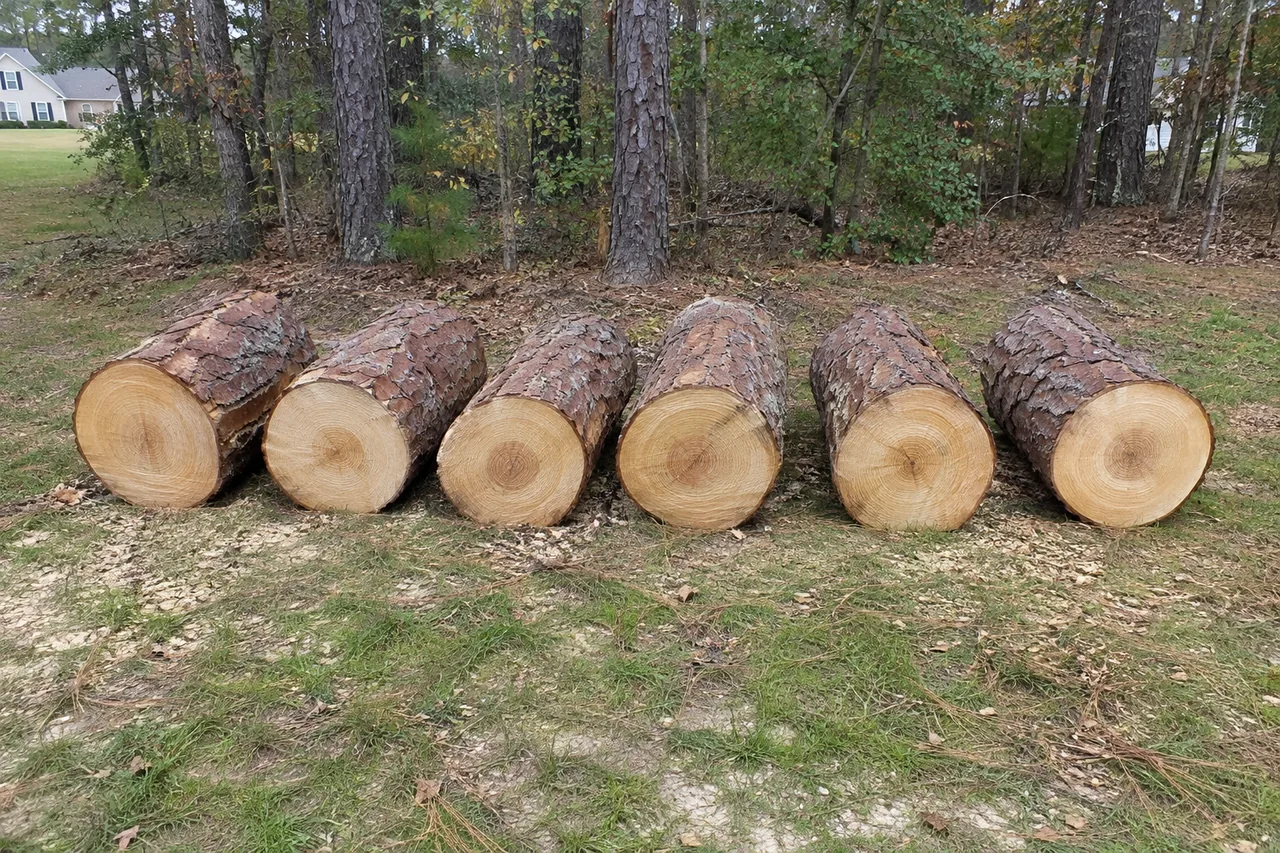
- Chips and firewood. Chipping on site leaves mulch for beds and paths, and straight trunk sections can stay as firewood.
Write the plan into the price: everything chipped and hauled, chips left in a pile, logs cut to stove length and stacked, or some mix of those.
Power lines and the wire to the house
Delmarva Power's customer handbook tells people to keep themselves, ladders and tools at least 10 feet from power lines and to call the company first, at 800-898-8042, before doing any work within 10 feet of one. Delaware Electric Cooperative serves most of rural Sussex; its outage line is 855-332-9090. Inside Lewes, electricity comes from the Lewes Board of Public Works, (302) 645-6228. Check the name on your bill and call that utility before a tree near any line is touched (checked Nov 9, 2026).
Mention the wires in your request. It changes who can do which part of the job and whether the line to the house needs to be dropped first.
The stump
A removal usually leaves a stump a few inches high unless the price includes grinding. Because a grinder works below the grass, Delaware requires a Miss Utility locate request at least two working days ahead and no more than ten, whatever the depth (checked Nov 9, 2026). See stump grinding for the rest.
Where removals go wrong
- Cutting first in Rehoboth or Dewey. Both towns treat an unpermitted removal as a violation, and Dewey's penalty for improper removal is $3,000 (checked Nov 9, 2026).
- A plan with no landing spot. A section dropped on the deck or the screened porch costs more than the removal.
- Machines on a saturated lawn. Ruts across a wet yard in March can take a season to fix.
- Assuming the brush will burn. State limits on season, hours and pile size leave a big removal's brush needing another plan.
- Private lines. Miss Utility doesn't mark wells, septic lines, sprinkler pipes, invisible fences or the water line from the meter to the house.
- Cleanup left out of the paperwork. Without it in writing, the log pile may stay in your yard.
Published removal prices
Thumbtack's national tree removal guide, last updated March 24, 2026, puts cutting down a single tree at $450 to $1,450, and $884 to $1,627 with the stump taken out too (checked Nov 9, 2026). It sorts trees by trunk diameter and crown spread rather than height. For a slim tree, trunk below a foot and crown no more than 30 feet wide, the range is $226 to $596. A trunk of one to two feet under a crown spreading past 30 feet costs $808 to $2,132. At the top of the table, a trunk two to three feet thick with a wide crown costs $1,562 to $4,117. These are national figures, not Sussex County prices. The full set is on what tree work costs.
When another guide fits better
A healthy tree that only crowds the roof may need trimming rather than removal. A tree already on the house belongs under storm and emergency removal. A tired Leyland cypress screen has its own guide, Leyland cypress removal. And clearing a wooded lot for a new house is land clearing, with stormwater plans and different equipment.
Removal questions
Does Sussex County require a permit to remove a tree from my yard?
Outside town limits, the county pages read for this site show none for an existing home lot (checked Nov 9, 2026). Rehoboth Beach and Dewey Beach do require one for most sizable trees. Call Planning and Zoning at (302) 855-7878 if your lot is in a newer subdivision with preserved woods.
How close to the house is too close to drop it whole?
If the tree is taller than the clear ground between it and the house, it can't simply be felled. The crew takes it down in sections, which costs more but keeps the pieces off the roof.
Can I keep the wood?
Usually. Ask for the trunk cut to firewood length and stacked; with less to haul, the price may come down.
Who decides about a tree beside a state road?
DelDOT. Call the South District office at (302) 853-1340 before anyone cuts near the pavement (checked Nov 9, 2026).
A request sent from this site reaches one independent contractor working in Sussex County. The site cuts no trees.
- City of Rehoboth Beach, Trees, and City Code Chapter 253; Town of Dewey Beach Code Chapter 173; City of Lewes Code §197-78.1 (Ord. 12-23) and §197-78.2; Town of Millsboro Code. All checked Nov 9, 2026.
- WHYY, Sussex County forest preservation ordinance, September 4, 2026. Sussex County Planning and Zoning. Checked Nov 9, 2026.
- Delaware Code Title 17, §525; DelDOT entrance and permit FAQs. Checked Nov 9, 2026.
- USDA soil series descriptions for Evesboro and Fallsington; USDA Forest Service Fire Effects Information System, Pinus taeda (Carey, 1992).
- DNREC open burning and residential burning pages, and yard waste drop-off list; Delaware Solid Waste Authority yard waste page; Town of Georgetown Code §185-3.1; City of Rehoboth Beach trash and yard waste page. Checked Nov 9, 2026.
- Delmarva Power customer handbook; Delaware Electric Cooperative; Lewes Board of Public Works; Miss Utility of Delmarva, homeowners page. Checked Nov 9, 2026.
- Thumbtack, Tree Removal Cost Guide 2026, updated March 24, 2026 (checked Nov 9, 2026).