
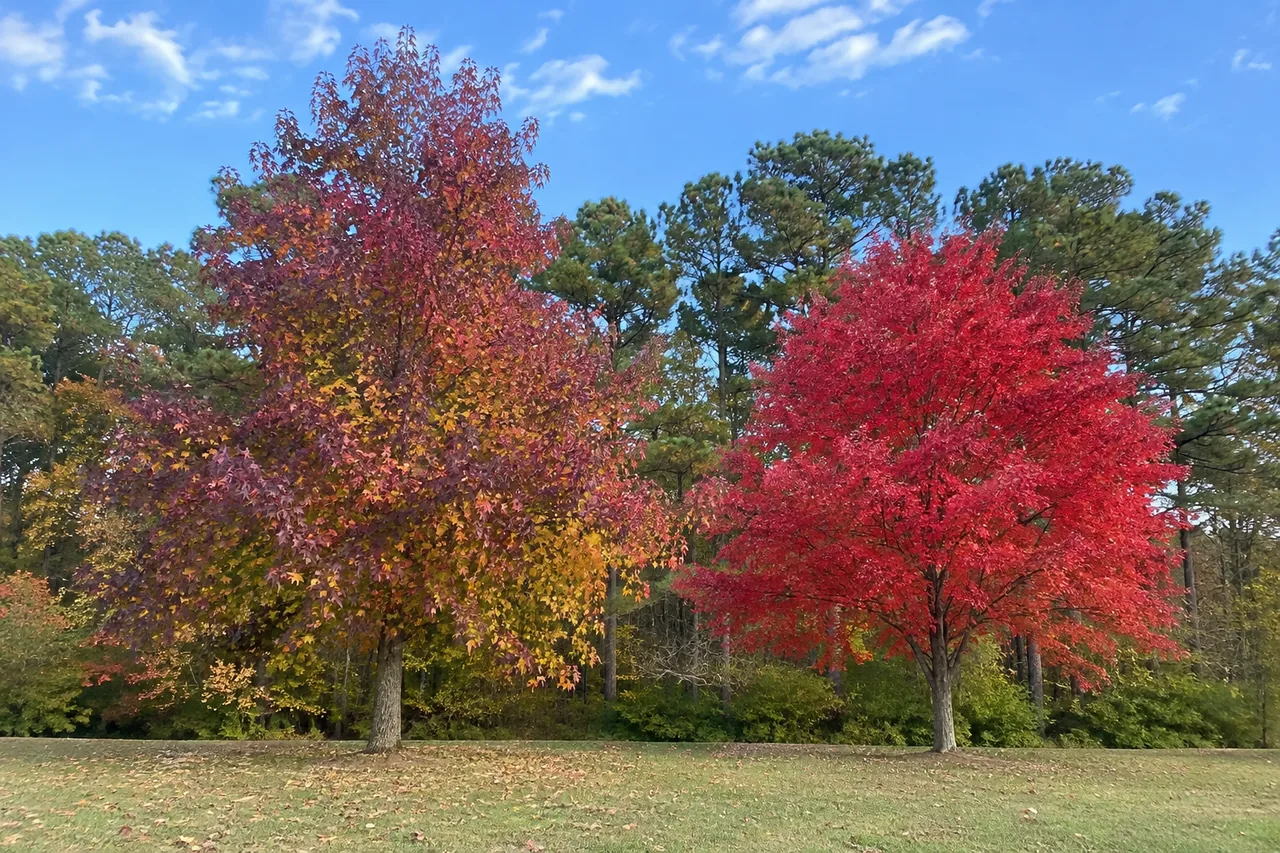
Yard trees at a glance
The wind column uses the four groups in a University of Florida Extension publication that sorted Coastal Plain trees by how they held up in hurricanes.
| Tree | Typical size | Wind group | What to watch |
|---|---|---|---|
| Loblolly pine | 90–110 ft at maturity | Medium-low | Windthrow on shallow soils; pine beetles |
| Red maple | 40–70 ft, 30–50 ft wide | Medium-low | Surface roots; branches break in wind and ice |
| Sweetgum | 60–100 ft, 40–50 ft wide | Medium-high | Shallow roots; spiky fruit litter |
| Willow oak | 40–75 ft, 25–50 ft wide | Medium-low | Listed as prone to wind damage |
| American holly | Varies | Highest | Snow damage noted in 2022 |
| Leyland cypress | 60–70 ft, 10–15 ft wide | Lowest | Cankers, bagworms, shallow roots |
| Bradford (Callery) pear | 30–50 ft, 20–35 ft wide | Lowest | Weak crotches that split with age |
| Black cherry | 60–80 ft, 30–60 ft wide | Medium-low | Tent caterpillars; leaves toxic to livestock |
Loblolly pine
Loblolly is a southern pine at the northern end of its home ground here. The Forest Service's species profile gives its native range as southern New Jersey to central Florida, Delaware included, with a mature height of 90 to 110 feet. On deep, sandy or loamy soil it sends down a taproot 4 to 5 feet long, and in large trees the side roots often spread wider than the crown. The same profile says loblolly is fairly windfirm where soils are deep but that windthrow is common on shallow soils.
Sussex County has both. USDA describes Evesboro sand as excessively drained, with the water table more than six feet down, and Fallsington soils as poorly drained, with a seasonal high water table within a foot of the surface from December through May. Loblolly is the managed woodland tree on Fallsington ground. A big pine on a low, wet lot faces winter storms with the water table close beneath its roots.
Pines here also turn red for reasons other than age. The Delaware Forest Service has recorded southern pine beetle kill beside a Sussex County salt marsh, and found salt spray and brackish flooding behind most of the red needles along the marshes. See dead or leaning trees.
Red maple
NC State Extension lists red maple as commonly 40 to 70 feet tall with a 30- to 50-foot spread, and says wind and ice can break some branches. Its roots are shallow and spread wide, forming a dense mat at the surface that can buckle a sidewalk or driveway planted too close. Possible problems include canker, root rots and Verticillium wilt, which can be fatal. USDA's description of Fallsington soils lists maples among the natural woods on that wet ground. The UF wind publication puts it in the medium-low group.
Sweetgum
Sweetgum can reach 60 to 100 feet with a 40- to 50-foot spread and a trunk four feet or more across, according to NC State, and it has a shallow root system. The complaint most owners have is the fruit: NC State calls the spiky balls a litter problem in lawns and on patios, dropping mainly from December through April. On wind, sweetgum does better than its neighbors; the UF publication puts it in the medium-high group. Wood rot and bleeding necrosis are among the problems NC State lists.
Willow oak and other oaks
Willow oak is a fast-growing shade tree, 40 to 75 feet tall and 25 to 50 feet wide, and can reach 100 feet. NC State says it resists pests better than most oaks but is susceptible to wind damage, and the UF publication places it in the medium-low group. Possible diseases include shoestring root rot and cankers.
On dry, sandy Evesboro ground, USDA lists black, white, red and chestnut oaks as the dominant wooded trees. Two other southern oaks, water oak and laurel oak, sit in the UF publication's lowest wind group; if one stands near the house, it deserves a closer look.
American holly
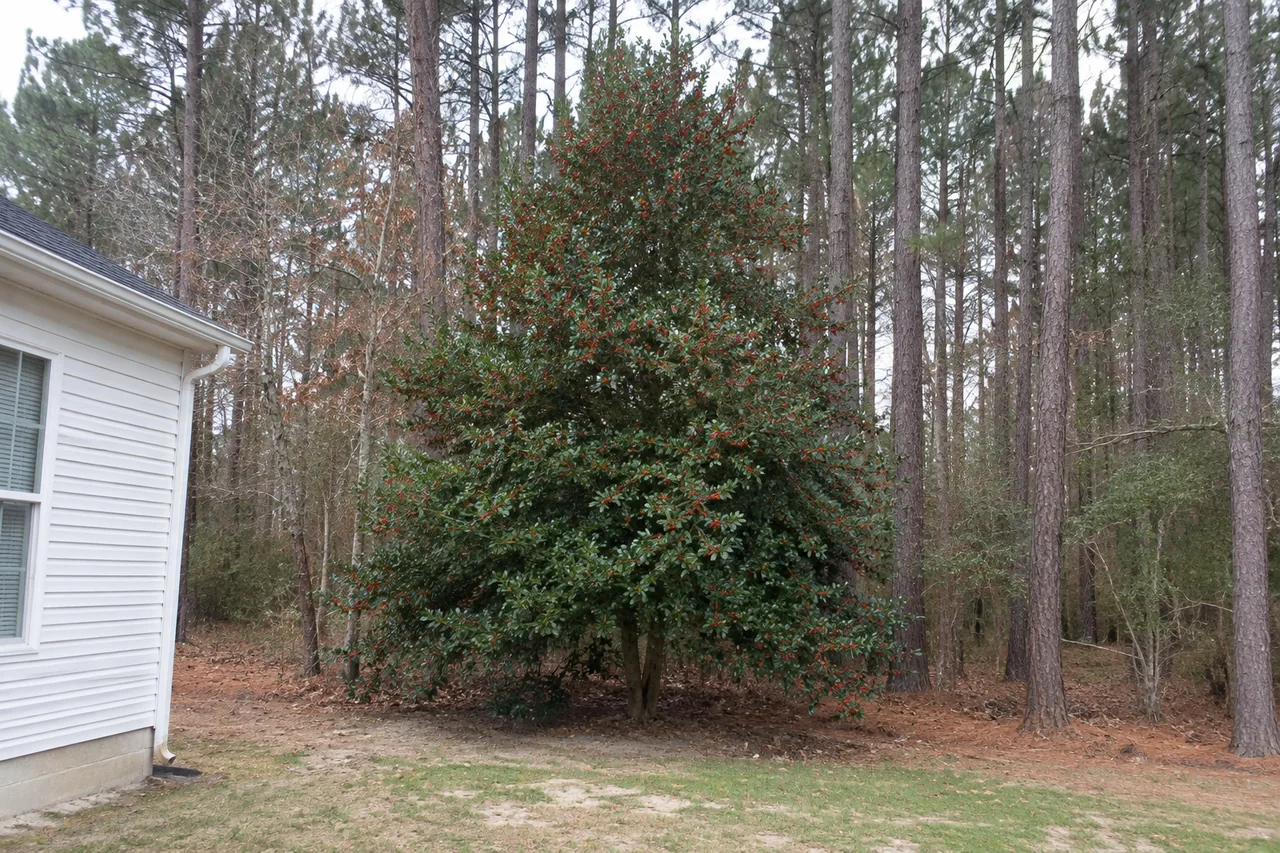
American holly has been Delaware's state tree since 1939, and a University of Delaware Extension piece notes that it once grew wild in abundance, especially in Sussex County. It ranks as the strongest of these yard trees in wind: the UF publication puts it in the highest group, with southern magnolia and live oak. It isn't immune to winter loads, though. The Delaware Forest Service's 2022 report noted that a January 29 snowfall that year caused further branch and trunk damage to conifers and American holly.
Leyland cypress
Planted for fast privacy, Leyland cypress grows up to 3 feet a year to 60 or 70 feet, NC State says, and typically lives 20 to 50 years. Its cankers, bagworms and shallow roots are covered in detail on the Leyland cypress page. In the UF wind publication it falls in the lowest group, and Rehoboth Beach's tree code lists it among the problem species whose removal can be permitted.
Bradford pear
NC State describes Bradford, a variety of Callery pear, as a 30- to 50-foot tree whose branches grow at steep angles, forming weak crotches that break with age, wind and ice. It is short-lived, and when it cross-pollinates with other trees its seedlings revert to the invasive Callery pear. The UF publication puts it in the lowest wind group. Delaware lists Callery pear on its Invasive Plant List, and state law bars buying, selling, transporting or propagating listed plants without the Agriculture Secretary's approval (checked Nov 9, 2026). Nothing in that law requires an owner to remove one already growing.
Black cherry
Black cherry grows quickly to 60 to 80 feet and 30 to 60 feet wide, per NC State, and sits in the UF publication's medium-low group. NC State warns that its leaves, fruit and seeds contain cyanide compounds and that eating them is likely to cause death in livestock and pets, worth knowing on any lot with a pasture. Tent caterpillars are among its listed pests.
Storms these trees have been through
- Aug 4, 2020, Isaias: gusts of 68 mph at Dewey Beach, 67 at Lewes, 59 at Long Neck and 58 at Rehoboth Beach and Georgetown, and an EF1 tornado in Milford that uprooted and snapped trees (NWS Mount Holly).
- Jan 29, 2022, snow: branch and trunk damage to conifers and American holly (Delaware Forest Service).
- Apr 1, 2023, tornado: an EF-3 from near Bridgeville to near Ellendale snapped or uprooted numerous trees (NWS Mount Holly).
- Feb 22–23, 2026, blizzard: up to 21 inches of snow near Long Neck, with trees, poles and lines down across the county (NWS Mount Holly; Sussex County).
More on these on the storm page.
Pests to know
- Southern pine beetle. Present in Sussex County, with low trap catches in 2022.
- Spongy moth (formerly called gypsy moth). The Delaware Forest Service mapped over 800 acres of defoliation statewide in 2022, and egg mass surveys in southern and southwestern Sussex County suggested more to come the next spring.
- Spotted lanternfly. The whole state was considered worthy of quarantine as of July 2022.
- Emerald ash borer. Much of the state's ash has likely been infested, but ash makes up about 1 percent of Delaware's forests and the southeast corner has very little (Delaware Forest Service, 2022 report; checked Nov 9, 2026).
- Bagworms. A serious threat to Leyland cypress, per NC State.
Choosing what to plant next
- Lean toward the strong end of the wind list. American holly and southern magnolia sit in the UF publication's highest group.
- Keep it off the wires. Delaware Electric Cooperative asks members to plant trees at least 25 feet from overhead lines, and taller-growing trees at least 40 feet away (checked Nov 9, 2026).
- Skip the invasive list. Callery pear is on it. In Lewes, trees planted to meet the city's tree density rule can't be invasive species (checked Nov 9, 2026).
- Match the ground. A tree for dry Evesboro sand is not necessarily one for a wet Fallsington lot. Ask a nursery or University of Delaware Cooperative Extension.
Questions about local trees
Are pines more dangerous than other trees?
Loblolly is tall, and on shallow or wet soils the Forest Service says windthrow is common. It ranks medium-low in the UF wind list, the same group as red maple and willow oak. Height and what's beneath it matter as much as species.
Is it legal to cut down my Bradford pear?
Yes, in most of the county. In Rehoboth Beach, Bradford pear is one of the problem species whose removal can be permitted, and the city's permit rules still apply (checked Nov 9, 2026).
Why are my sweetgum's roots coming up through the lawn?
NC State describes sweetgum's roots as shallow. Red maple's are shallow too, forming a surface mat.
Which tree is the toughest choice for a windy lot?
Of the trees on this page, American holly ranks highest for wind resistance in the UF publication.
This site sends tree requests to one independent contractor who works in Sussex County. It doesn't sell, plant or cut trees.
- Duryea and others, Selecting Coastal Plain Species for Wind Resistance, UF/IFAS Extension FR174.
- USDA Forest Service, Fire Effects Information System, Pinus taeda (Carey, 1992).
- USDA soil series descriptions: Evesboro, Fallsington.
- NC State Extension Plant Toolbox: Acer rubrum, Liquidambar styraciflua, Quercus phellos, Pyrus calleryana, Prunus serotina, x Cuprocyparis leylandii.
- University of Delaware Cooperative Extension, American holly, November 28, 2012.
- Delaware Forest Service, Forest Health Highlights 2016 and 2022.
- NWS Mount Holly storm summaries for Isaias (2020), April 1, 2023 and February 22–23, 2026; Sussex County release, February 22, 2026.
- Delaware Code Title 3, Chapter 29; 3 DE Admin. Code 806; City of Rehoboth Beach Code Chapter 253; City of Lewes §197-78.1; Delaware Electric Cooperative. Checked Nov 9, 2026.