
Why so many Leyland screens are failing
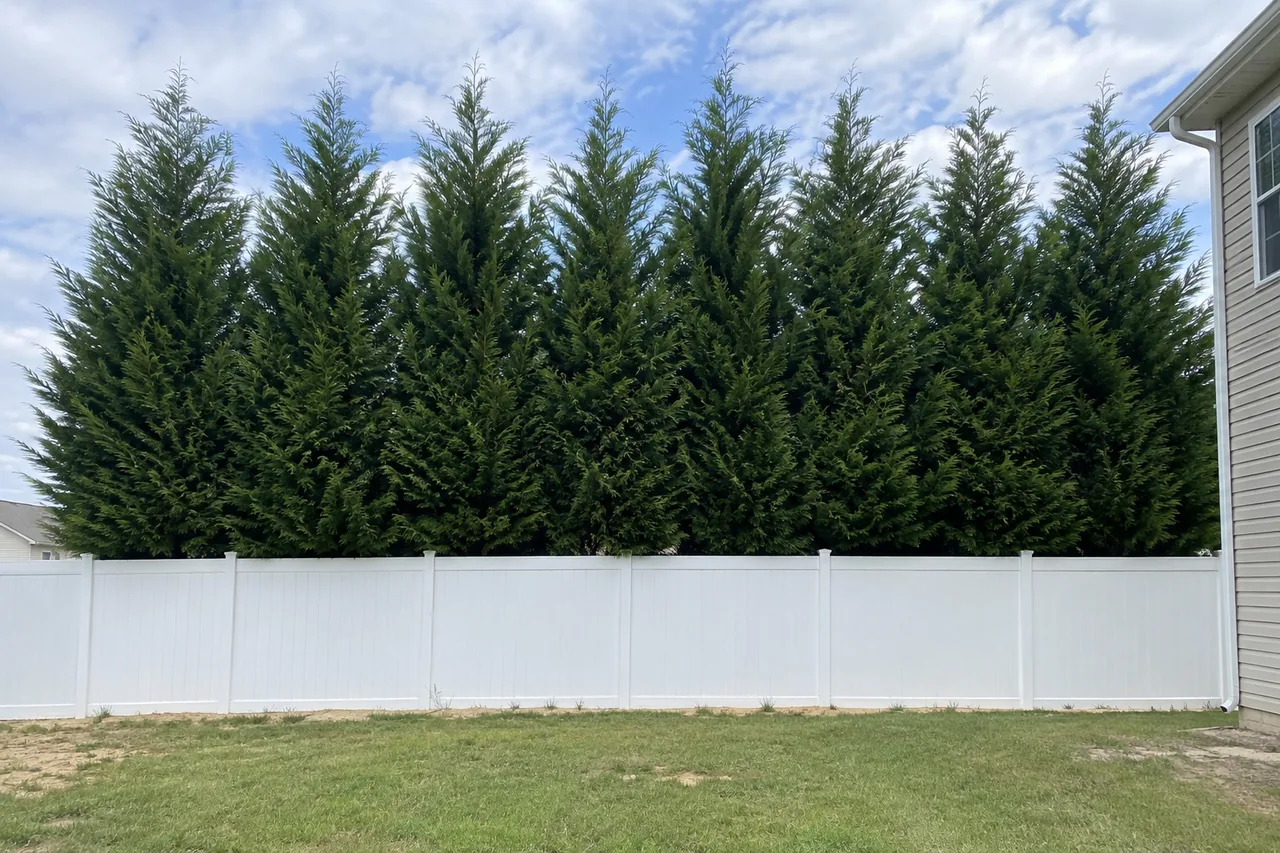
The appeal is speed. NC State Extension's plant notes say young Leylands can add up to 3 feet a year and reach 60 to 70 feet tall and 10 to 15 feet wide. The same notes call the tree "severely pest- and disease-prone" and say these trees typically live 20 to 50 years, depending on where they grow.
University of Delaware Cooperative Extension saw the trouble coming. A 2008 post by UD's Gordon Johnson listed Seiridium canker, Botryosphaeria dieback and Cercosporidium needle blight as increasingly common in landscapes, along with bagworms and spider mites, and named the usual planting mistakes: wet soil, shade, spots under utility lines, and trees crowded together for instant privacy. A 2009 follow-up added that some nursery cuttings never root well and are prone to blowing over in heavy wind.
Canker: the brown branches
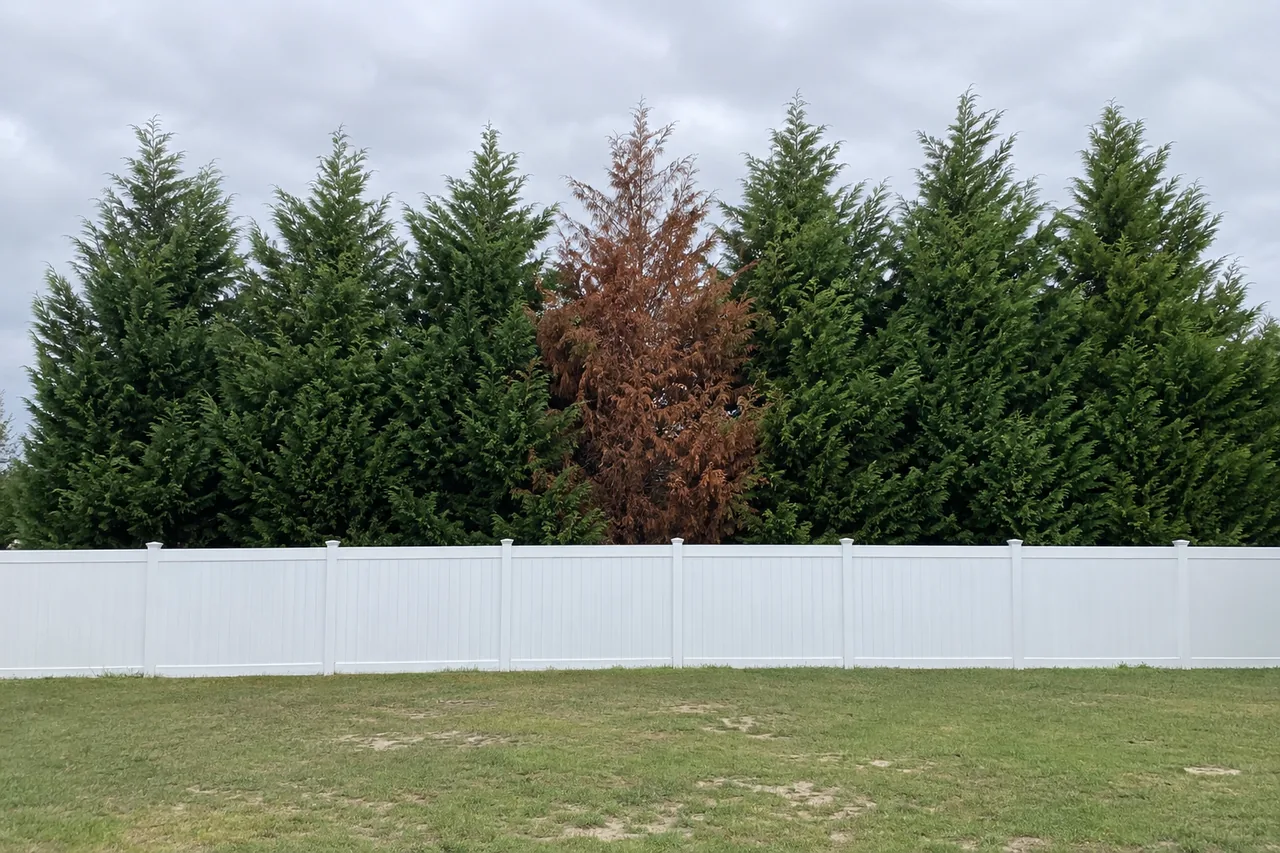
University of Maryland Extension singles out two fungal cankers behind scattered brown branches on Leylands and describes the pattern: foliage on scattered side branches yellows or fades, then turns reddish brown, and dark, cracked patches form on the bark.
- Seiridium canker often shows tiny black fruiting dots on the canker and resin oozing from it, though healthy Leylands can bleed resin too. UD's 2009 post says infected limbs turn yellowish, then brown to gray as they die.
- Botryosphaeria canker forms its fruiting bodies just under the bark, usually with little resin, and can produce long cankers on the main stem.
Both strike mainly when trees are stressed, especially by drought, and spread when spores wash onto other branches in rainy spring weather. Maryland Extension notes that infection on several branches or on the trunk can kill the tree. University of Maryland Extension is direct about treatment: fungicides are not effective. Its advice is to water and mulch in dry spells, avoid heavy fertilizing, and prune infected branches several inches below any visible canker. UD's post adds that roots kept too wet or too dry make trees more susceptible, and that limbs rubbing between crowded trees open wounds for infection.
Bagworms
NC State's notes warn that bagworms can strip an entire Leyland in a few weeks. UD's 2008 post makes the practical point: once the trees are tall, treatment is difficult or impossible for most homeowners. A row that has been allowed to reach 40 or 50 feet is hard to protect from either bagworms or cankers.
Shallow roots and wind-throw
Leylands fail in storms differently from pines. NC State notes that their branches are sturdy and resist breaking, but that their roots are relatively shallow and large trees may fall over. UD's 2008 post connects the same shallow roots to drought stress and to trees "topping over in storms." In the University of Florida Extension ranking of Coastal Plain trees by wind resistance, Leyland cypress sits in the lowest group.
So when a big Leyland fails in a storm, it tends to be the whole tree going over rather than a single limb. A row standing in a low, wet spot, or one with trees that already lean, is worth a look before the winter storm season.
One brown tree, or the whole row?
Each screen is different, but a few patterns help sort out the choice:
- A few brown branches on otherwise full trees. Pruning infected branches well below the canker, as Maryland Extension advises, and keeping the row watered in dry spells may buy years.
- One or two whole trees dead in the middle. Removing those trees opens a gap, but it also gives the neighbors on each side more air. UD's 2009 advice was not to space Leylands closer than 8 feet and to remove every other tree as they mature, because rubbing limbs open wounds.
- Browning in many trees, thin bottoms, or trees leaning. The row is probably near its end. Taking it out in one visit avoids repeat trips and lets the replacement planting go in together.
- A row that has outgrown the space. At 60 to 70 feet, nothing about a Leyland screen can be maintained from the ground.
How a row comes out beside a fence and a house
A privacy screen is usually planted along a property line, often near a fence, with a house or a neighbor's yard close by. That shapes the job:
- Top down, in pieces. Tall trees near a fence or building are taken down in sections, with the top pieces roped or dropped into the open yard rather than over the fence.
- Access. How wide the gate is, whether a fence panel can come off, and whether a chipper can reach the backyard decide how much is carried by hand.
- Brush volume. A row of evergreens produces a large pile of foliage. Chipping on site is the usual answer, since Delaware's burning rules allow homeowners only 27 cubic feet at a time, only from October through April, after notifying the county fire board (DNREC, checked Nov 9, 2026).
- Stumps. If the stumps will be ground so the fence line can be replanted, Delaware requires a Miss Utility ticket at least 2 and no more than 10 working days ahead (checked Nov 9, 2026). Point out sprinkler lines, invisible fencing and anything else buried along the fence; those aren't marked.
- The neighbor. If the trees are close to a shared fence, let the neighbor know when the crew is coming. If any tree is on or over the line, sort out ownership before work starts.
Town permits
Most of Sussex County asks for no permit to take Leylands off a home lot. Two beach towns are exceptions (both checked Nov 9, 2026):
- Rehoboth Beach generally requires a permit to remove trees. Its tree chapter names Leyland cypress, with Ailanthus, Bradford pear, Japanese black pine and Norway maple, among the problem species whose removal can be permitted. Fees are $25 per tree plus $100 for a 16- to 24-inch trunk or $300 above 24 inches (checked Nov 9, 2026). City arborist: 302-227-6181, ext. 207.
- Dewey Beach requires a permit for any tree 20 inches or more around, measured one foot above the ground, and certain removals call for a native replacement tree within 90 days (checked Nov 9, 2026). Pruning or reducing trees also needs a permit there, which the town doesn't charge for.
Lewes, Milton, Georgetown, Millsboro and the unincorporated county showed no home-lot removal permit in the pages read for this site (checked Nov 9, 2026). The rules guide has the details.
What Leyland removal costs
No published price list covers Leyland rows specifically. Thumbtack's national tree removal guide, last updated March 24, 2026, prices single trees by trunk width and crown spread. A narrow evergreen with a trunk below a foot and a crown no wider than 30 feet falls in its $226 to $596 tier; with a trunk of one to two feet, the tier is $517 to $1,364. Grinding a stump less than a foot wide is $267 to $354, and one to two feet wide is $324 to $443 (all checked Nov 9, 2026). Those tiers describe one tree at a time; a contractor prices a whole row as a single job, and access, the fence, the brush and the stumps all move the number. See what tree work costs.
What to plant instead
UD's 2009 post listed replacements for Leyland screens: 'Green Giant' arborvitae, 'Foster's' holly, 'Nellie R. Stevens' holly, lusterleaf holly, 'Little Gem' and 'Bracken's Brown Beauty' magnolias, and Eastern red cedar, which it noted grows slowly. Clemson Extension's alternatives fact sheet adds Arizona cypress, Japanese cedar, sweetbay magnolia and wax myrtle, and points out that a screen 6 to 15 feet tall is often all the privacy a yard needs.
A few more points for Sussex County:
- American holly is Delaware's state tree, grew wild across Sussex County according to UD, and ranks in the highest wind-resistance group in the University of Florida list.
- Space it. Give each plant room for its mature width instead of planting for instant cover.
- Mind the wires. Delaware Electric Cooperative asks members to plant trees at least 25 feet from overhead lines, and taller-growing trees at least 40 feet away (checked Nov 9, 2026).
- Skip the invasive list. Callery pear is on Delaware's invasive plant list, and state law bars selling listed plants. In Lewes, trees planted to meet the city's tree density rule can't be invasive species (both checked Nov 9, 2026).
Leyland mistakes to avoid
- Spraying for canker. Maryland Extension says fungicides don't work on it.
- Letting the row run tall. Height takes bagworm and canker control out of reach.
- Pulling one tree and replanting another Leyland in the gap. The new tree goes into the same crowded, infected row.
- Cutting first in Rehoboth or Dewey Beach. Both require permits for sizable trees (checked Nov 9, 2026).
- Forgetting the stumps. If you want to replant along the same line, plan for grinding and a Miss Utility ticket.
Leyland questions
Can a browning Leyland be saved?
If only scattered branches are affected, pruning them out well below the canker and keeping the tree watered in dry weather may help. If the trunk is cankered or most of the tree is brown, it won't recover.
Why did my Leyland fall over in one piece?
Extension sources from UD and NC State both point to shallow roots. Their branches resist breaking, so the whole tree tends to go when the roots let go.
Do I need a permit to remove Leylands in Rehoboth Beach?
Generally yes. Rehoboth's code names Leyland cypress among the problem species whose removal can be permitted, with fees by trunk size (checked Nov 9, 2026).
What grows fast enough to replace them?
UD's list starts with 'Green Giant' arborvitae and several hollies. Ask a local nursery or University of Delaware Cooperative Extension what does well in your soil and exposure.
Requests sent from this site go to one independent contractor who works in Sussex County. The site removes no trees itself.
- University of Delaware Cooperative Extension, Kent County, Gordon Johnson: Landscape Leyland cypress problems, March 9, 2008, and Landscape problems with Leyland cypress, November 8, 2009.
- University of Maryland Extension, Seiridium and Botryosphaeria canker of Leyland cypress.
- NC State Extension Plant Toolbox, x Cuprocyparis leylandii.
- Clemson Cooperative Extension, Leyland Cypress Alternatives, HGIC 1025, March 21, 2007.
- Duryea and others, Selecting Coastal Plain Species for Wind Resistance, UF/IFAS Extension FR174. UD Cooperative Extension, American holly, November 28, 2012.
- City of Rehoboth Beach Code Chapter 253; Town of Dewey Beach Code Chapter 173; City of Lewes Code §197-78.1. Checked Nov 9, 2026.
- DNREC residential open burning; Miss Utility of Delmarva homeowner page; Delaware Electric Cooperative tree trimming page; Delaware Code Title 3, Chapter 29, and invasive plant regulation. Checked Nov 9, 2026.
- Thumbtack, Tree Removal Cost Guide 2026, updated March 24, 2026 (checked Nov 9, 2026).